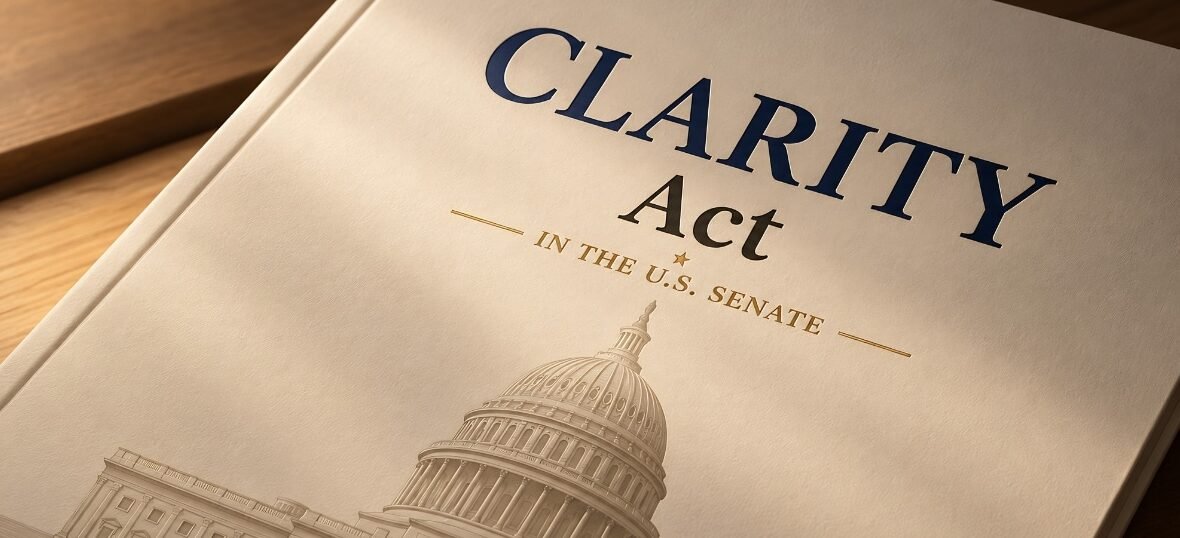
NEW DELHI:- The global cryptocurrency industry may be approaching its most defining regulatory turning point yet as the United States moves closer to establishing a formal legal framework for digital assets through the proposed Digital Asset Market CLARITY Act.
For more than a decade, the world’s largest crypto market operated without clear boundaries between regulators. The US Securities and Exchange Commission and the Commodity Futures Trading Commission frequently asserted overlapping authority over digital assets, leaving exchanges, investors, and institutions navigating years of legal uncertainty. The absence of a clearly defined framework often slowed institutional participation, product innovation, and broader market adoption.
That uncertainty may now begin to change. The US Senate Banking Committee has advanced the Digital Asset Market CLARITY Act, one of the most comprehensive crypto regulatory proposals introduced in the country so far. The legislation seeks to formally define whether digital assets fall under securities or commodities regulation while also addressing stablecoins, decentralised finance platforms, investor safeguards, insider trading concerns, and bankruptcy protections for crypto customers.
The market reacted positively following the development, with major digital assets including Bitcoin and Ethereum witnessing gains as investors interpreted the move as a sign of increasing regulatory maturity within the sector.
Ashish Singhal described the proposed legislation as a structural shift for the global crypto ecosystem, stating that regulatory ambiguity surrounding digital assets has remained one of the industry’s biggest unresolved challenges for years. He noted that frameworks such as the CLARITY Act could eventually become global reference points for how crypto assets are integrated into mainstream financial systems.
Industry leaders believe the impact extends far beyond asset classification. Clear regulatory structures are increasingly viewed as essential for attracting institutional capital, accelerating exchange-traded product growth, and enabling deeper integration between traditional finance and digital assets.
Nischal Shetty highlighted that uncertainty around regulatory jurisdiction has historically prevented exchanges and institutions from building products with confidence. According to him, the US development could become an important reference point for Indian policymakers as India continues to witness rapid growth in virtual digital asset participation despite lacking a comprehensive legal framework.

India currently taxes digital asset transactions through a 30 percent tax on gains and a 1 percent TDS mechanism, but the country still lacks formal legislation governing asset classification, investor protection, and regulatory oversight. The development in the United States is therefore being closely watched within India’s crypto industry and fintech ecosystem.
The evolving global landscape is also drawing comparisons with Europe’s Markets in Crypto Assets framework, which created a unified compliance structure across European Union markets and significantly improved institutional confidence across the region.
Also Read:-https://medianoise.in/nat-habit-ayurveda-dandruff-care-goflakezero/
Vikaas M Sachdeva said every financial category eventually reaches a stage where growth must be supported by accountability, operational clarity, and long-term legitimacy. He added that India already possesses one of the world’s most digitally active investor bases and could play a major role in shaping the next phase of the global digital asset industry.
While the CLARITY Act still requires approval through additional legislative stages in the United States, the bill is already being viewed as a potentially historic shift that could influence crypto regulation, institutional participation, and digital asset policymaking far beyond American markets.